Your Work Isn't Inferior — Your Feed Is Just Lying to You

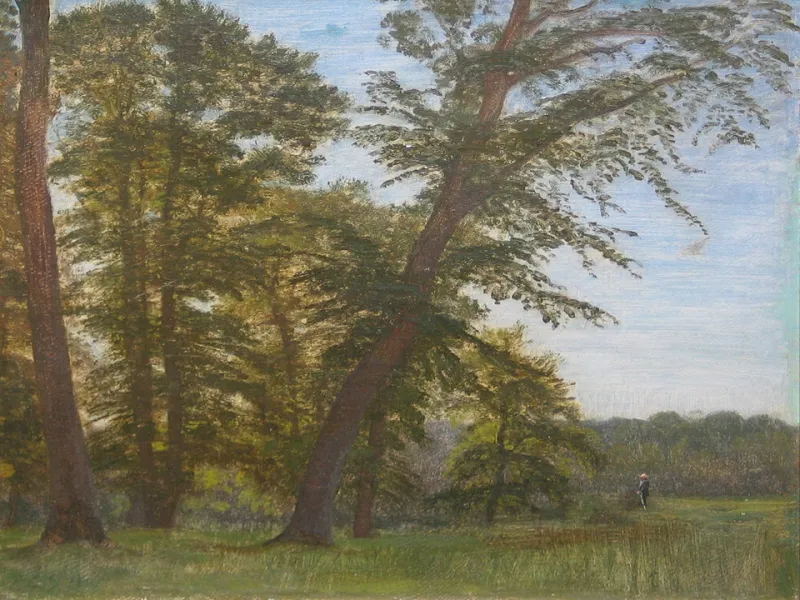
Photo: Photograph by Mike Peel (www.mikepeel.net)., CC BY-SA 4.0, via Wikimedia Commons
There's a specific kind of awful that happens when you finish something you were genuinely proud of, post it, and then — almost immediately — stumble across someone else's version of the same idea. Except theirs has better lighting, a sharper concept, and somehow already has 40,000 likes. You close the app. You reopen it. You look at your own post and it suddenly feels like something a middle schooler made on a free trial of Canva.
That feeling has a name. And more importantly, it has a mechanism — one that's worth understanding if you want to stop letting it run your creative life.
The Algorithm Isn't Showing You Reality
Here's the thing nobody really says out loud: your social media feed is not a representative sample of human creative output. It's a curated, engagement-optimized highlight reel built by systems designed to surface the most arresting, most polished, most already-validated content possible. The algorithm isn't showing you the 10,000 creators who posted something similar to you this week and got 200 views. It's showing you the one person who went viral.
This matters because your brain doesn't naturally make that distinction. Psychologists call it the "social comparison theory" — the idea that humans instinctively measure their own standing by looking at others. It's an old survival mechanism that worked reasonably well when your reference group was your actual neighborhood. It becomes a slow-moving disaster when your reference group is suddenly every talented person on the internet, filtered specifically for peak performance.
You're not comparing yourself to average. You're comparing yourself to the statistical outlier, every single time you open your phone.
Why Creatives Are Especially Vulnerable
Comparison hits creative people differently than it hits, say, accountants. When your work is personal — when it carries your voice, your perspective, your specific way of seeing the world — criticism or perceived inadequacy doesn't feel like a performance review. It feels like a verdict on you.
And because creative output is genuinely subjective, there's no clean metric to anchor yourself to. A software engineer can point to shipping a working product. A creator staring at engagement numbers is trying to quantify something that resists quantification. So we borrow other people's metrics. We use their follower counts, their production budgets, their viral moments as a measuring stick for our own worth. It never ends well.
There's also something sneaky happening with what researchers call "upward comparison" — the tendency to compare yourself specifically to people doing better than you, rather than those at a similar stage. Social platforms make upward comparison almost automatic. You're not seeing the creator who's six months behind you, grinding through the same uncertainty you were dealing with last year. You're seeing the person three years ahead of you on the best day of their career.
The Stories We Don't See
Let's talk about what actually goes into the work you're comparing yourself against.
That photographer with the immaculate editorial spread? They've probably been shooting for a decade, spent thousands on gear, and had that particular image retouched by someone who does it professionally. The newsletter writer with 80,000 subscribers? They likely spent two years writing to 200 people before anything clicked — and there's a decent chance they've had more flops than you've had posts.
The version of success you see online is real, but it's also radically incomplete. It's missing the failure pile, the awkward middle period, the stuff that got deleted, the collaborators who helped, the money spent, the time invested. What you're comparing your full, unedited experience to is someone else's edited trailer.
When you start asking yourself "why isn't my work as good as theirs," the more honest question might be: "am I comparing my process to their product?"
Reframing the Metric That Actually Matters
The creators who seem to genuinely outgrow the comparison trap aren't the ones who stop caring about quality. They're the ones who get very specific about what success means for them, at this stage, with these resources.
That specificity is the key. Vague ambition is comparison fuel. "I want to be a successful creator" is a sentence that will have you measuring yourself against every successful creator you encounter. But "I want to consistently produce work that reflects my actual perspective, and grow an audience that resonates with that specific thing" — that's something you can actually evaluate on your own terms.
A few practical reframes that actually work:
Track your own trajectory, not someone else's. Pull up something you made a year ago. If there's growth, you're moving. That's the only race that's real.
Use admiration as information, not indictment. When you see work you genuinely love, the useful question isn't "why can't I do that?" It's "what specifically is working here, and what can I learn from it?" Admiration is data. Let it be useful instead of painful.
Audit your inputs. If certain accounts consistently make you feel worse about your own work without offering anything genuinely educational or inspiring, that's not inspiration — that's self-inflicted punishment. Curate ruthlessly.
Separate the product from the platform. Engagement is a measure of distribution and timing and algorithmic favor as much as it is quality. Work that doesn't perform isn't necessarily work that doesn't matter.
The Long Game Looks Different Up Close
Some of the most interesting creative careers — the ones that actually last — don't look impressive in the middle. They look like someone stubbornly making things that feel true to them while everyone else chases whatever format is currently winning the algorithm lottery.
The comparison trap is, at its core, a short-term thinking problem. It measures today's output against someone else's peak moment and concludes you're losing a race you were never actually running.
Your creative work has a compounding quality that doesn't show up in a single post's performance. The skills you're building, the voice you're developing, the audience you're slowly earning trust from — none of that is visible in a like count. But it's real, and it accumulates.
So the next time the scroll leaves you feeling like your work doesn't measure up, try to remember: the feed isn't the landscape. It's a funhouse mirror. And you're not obligated to use it as your measuring stick.
Make the thing. Post it. Then close the app before the algorithm has a chance to convince you it wasn't worth making.